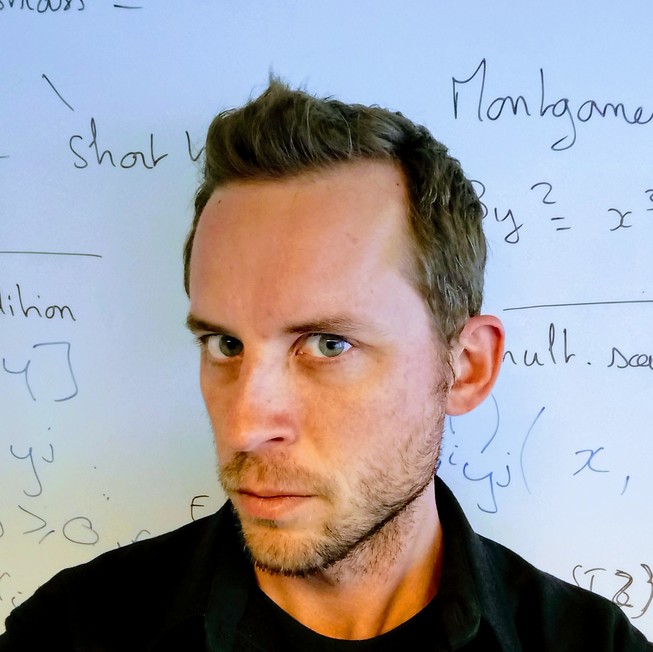
I studied algorithmic number theory in Sydney with David Kohel. I worked as a postdoc at Royal Holloway with Steven Galbraith. I've been at LIX, and with INRIA, since November 2007.
I am currently running the CACHACA Action Exploratoire at Campus Cyber and am leading Inria's participation in the HYPERFORM consortium. I am also on the editorial board for Communications in Cryptography, a new diamond-access journal published by the IACR.
Wave is a post-quantum signature scheme based on hard problems in coding theory. Gustavo Banegas, Kévin Carrier, André Chailloux, Alain Couvreur, Thomas Debris-Alazard, Philippe Gaborit, Pierre Karpman, Johanna Loyer, Ruben Niederhagen, Nicolas Sendrier, and Jean-Pierre Tillich and I have submitted Wave to the fourth-round Signature On-Ramp of the NIST Post-Quantum Cryptography Standardization Project. The project website is at https://wave-sign.org and the source code for the reference implementation is available at https://github.com/wavesign.
Gustavo Banegas, Daniel J. Bernstein, Fabio Campos, Tung Chou, Tanja Lange, Michael Meyer, Jana Sotáková, and I have a developed a new algorithm and keyspace for fast constant-time CSIDH, an algorithm for postquantum non-interactive key exchange. The code and details are on a dedicated website: https://ctidh.isogeny.org/
Daniel J. Bernstein, Luca De Feo, Antonin Leroux, and I have a developed new algorithms for computing prime-degree isogenies in square-root time (as opposed to linear time, which is how we've been doing things since the seventies). The details are on a dedicated website: https://velusqrt.isogeny.org/
Joost Renes, Peter Schwabe, Lejla Batina, and I developed μKummer: an efficient, open implementation of Diffie–Hellman key exchange and Schnorr signatures for 8- and 32-bit microcontrollers (AVR ATmega and Cortex M0), based on genus 2 curves. The project is described in our CHES 2016 paper, and the source code is publicly available from Joost's site.
μKummer is more or less superseded by qDSA, a Kummer-only signature scheme (similar to EdDSA) developed for microcontrollers that Joost and I designed to use much less stack space. The details are in the preprint of our ASIACRYPT 2017 paper, and the reference implementation is available from Joost's site.
Craig Costello, Huseyin Hisil, and I developed a fast, open, compact Diffie–Hellman implementation targeting the 128-bit security level on 64-bit Intel platforms. The project is detailed in our Eurocrypt 2014 paper, and the source code is publicly available from Huseyin's site. Craig has also made the Magma code from this project available.
Data files for the article Families of explicitly isogenous Jacobians of variable-separated curves can be found here. The polynomials in these files also appear in Families of Explicit Isogenies of Hyperelliptic Jacobians, and are based on the exceptional pairs of polynomials in Pierrette Cassou-Noguès and Jean-Marc Couveignes' "Factorisations explicites de g(y)-h(z)".
I get a lot of spam about 2- or 3-month "summer internships". If you put "summer internship" in the subject line of an email, then I will assume it is spam and delete your email without reading it. And if it looks like spam, then I'll just delete it anyway.
Preparing worthwhile internships takes time, especially in France, and especially at École polytechnique. Once a subject is agreed on, local security rules generally add two to three months' worth of paperwork, with no guarantee of approval—especially if you are not a French citizen (I don't make the rules).
So: if you're really interested in working here, then you need to have a strong background in mathematics (especially algebra) and computer science, and you also need get in touch way in advance.